

Here’s how most business owners self-diagnose their financial problems:
Sales aren’t growing as fast as I want
I’m going to run out of cash in a few weeks
I haven’t touched my books in a few months
I’m not making any money (profit) in this business
I have this big loan payment I’m making every month
From there, your options are to dig in, figure out what’s broken, and how to fix it on your own. Or hire someone to tell you what’s broken, then go fix it on your own.
In both scenarios, you still have to figure out what’s broken…

What if there was a faster (and easier) path to finding the solution to: “go fix this first!”
Defining Your Situation
What does it mean to define your “financial situation?”
Using a simple checklist, you’re defining the current financial state of your company and you as owner.
When you go to the doctor, they (hopefully) run some tests before suggesting a treatment. We can do the same for your business and we don’t need to do any deep analysis to answer these questions. “Do you have debt? Yes! I have a big bank loan with a big monthly payment!” (Though you’re probably not saying that excitedly.)
Financial Situation: Quick assessment to determine the state of your business and the optimal starting point with the Profit Mastery financial operating system.
Tool: Financial Situation Checklist
When it comes to managing your financials, nothing matters more than knowing where you stand today. It’s jumping into the deep end of the pool without knowing how to tread water first.
The Checklist
Answer 9 simple “yes/no” questions covering: the quality of your data, your current financial acumen, and the financial condition of your business.
Your answers to these questions will determine where you start in the Financial Operating System:
Data — do you trust the numbers?
Books closed within 30 days of month-end?
Business and personal money fully separated?
You look at the financials at least monthly?
Acumen — can you read the numbers?
Do you know your gross margins without looking them up?
Do you know your breakeven sales level?
Can you explain where your cash went last month?
Condition — where does the business stand?
Debt payments comfortably covered by cash flow?
Operating above breakeven?
More than 3 months of cash runway?
Interpreting your results
The first “no” determines your implementation starting point:
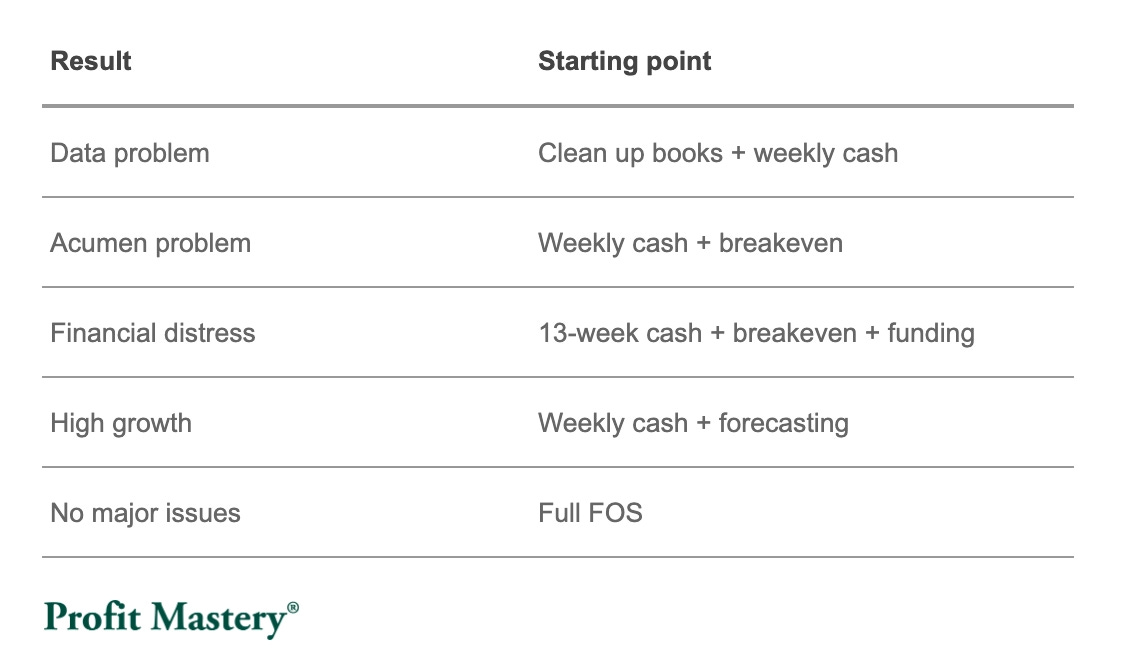
“No” in 1–3 — Fix your financial data (hire a quality bookkeeper) and start with a weekly cash flow (it’s the only tool which doesn’t require a set of financials). Once you have good data, start from the beginning of the system or re-run this checklist.
“No” in 4–6 — Start with a weekly cash flow which requires minimal accounting knowledge, then nail down your cost structure (breakeven) which is a relatively simple concept. As your financial acumen builds, work the system from start to finish.
“No” in 7–9 — A “no” in this group signifies limited time to execute the system (short runway) either from: (a) too much debt or high debt payments; (b) an unprofitable business losing money; or (c) too little cash on hand or heavy cash outflows. Under any of these scenarios: you may need to refinance/restructure debts or raise capital, manage to a 13-week cash forecast until you can live within your means, and clean up your cost structure (find and reduce your breakeven point).
All yes answers — Run the full system from start to finish.
There are a few caveats/overrides to the list above…
If your business is a startup (I’ll define this as less than 2 years old) or below $1 million in revenue, then your primary focus is probably getting to breakeven which means finding that sales level and pushing for enough growth to get there. (These are rules of thumb, I say probably because it’s possible to have a profitable business at less than $1 million revenue or a startup with plenty of financial backing intentionally running below breakeven.)
If your business is growing faster than 20% per year — You’re running a high growth business. Setting aside the constant barrage of operational challenges; from a financial standpoint, this means you need to focus on short-term cash management (weekly cash flow) and long-term cash management (budgeting & forecasting). Under a constant state of change, you need to get very good at predicting where the business is heading.
Still work the questionnaire, but add these to your plate if you meet any of these exceptions.
To summarize the checklist, it looks something like this:
How to use this information
This checklist shouldn’t take more than 15 minutes to complete and will require very minimal “lookup” effort.
Think of this as a routing tool as opposed to a financial health diagnostic. There’s no “grade” at this point, we’re just answering the question:
“What should I work on first?”
Why the “data → acumen → business condition” sequence?
If you have a data problem, the information is unreliable and it makes no sense to review unreliable financials. Get the books current, separate personal/business activity, and establish a regular review cadence.
If you have an acumen problem, then you have good information but you don’t know how to read it. Start with the simplest financial tools (weekly cash flow and breakeven) before trying to interpret more advanced reports.
If you have a business condition problem, then you know the information, but it might feel like the walls are closing in on you. Stabilize the business first: preserve cash, reduce breakeven, address debt, or get additional funding.
If the business is growing quickly (which is not necessarily a problem), then you need to prioritize forecasting and cash planning so growth does not outrun capital.
You’re not stuck in these buckets forever.
Remember, this is a routing tool. Fix or stabilize whichever bucket you’re in, re-run the questionnaire, and move on to the next part of the Financial Operating System.
Thanks for reading! Subscribe or stay tuned as we continue building out the rest of this system.
P.S. leave a comment and let me know where your first “no” popped up in the checklist.