

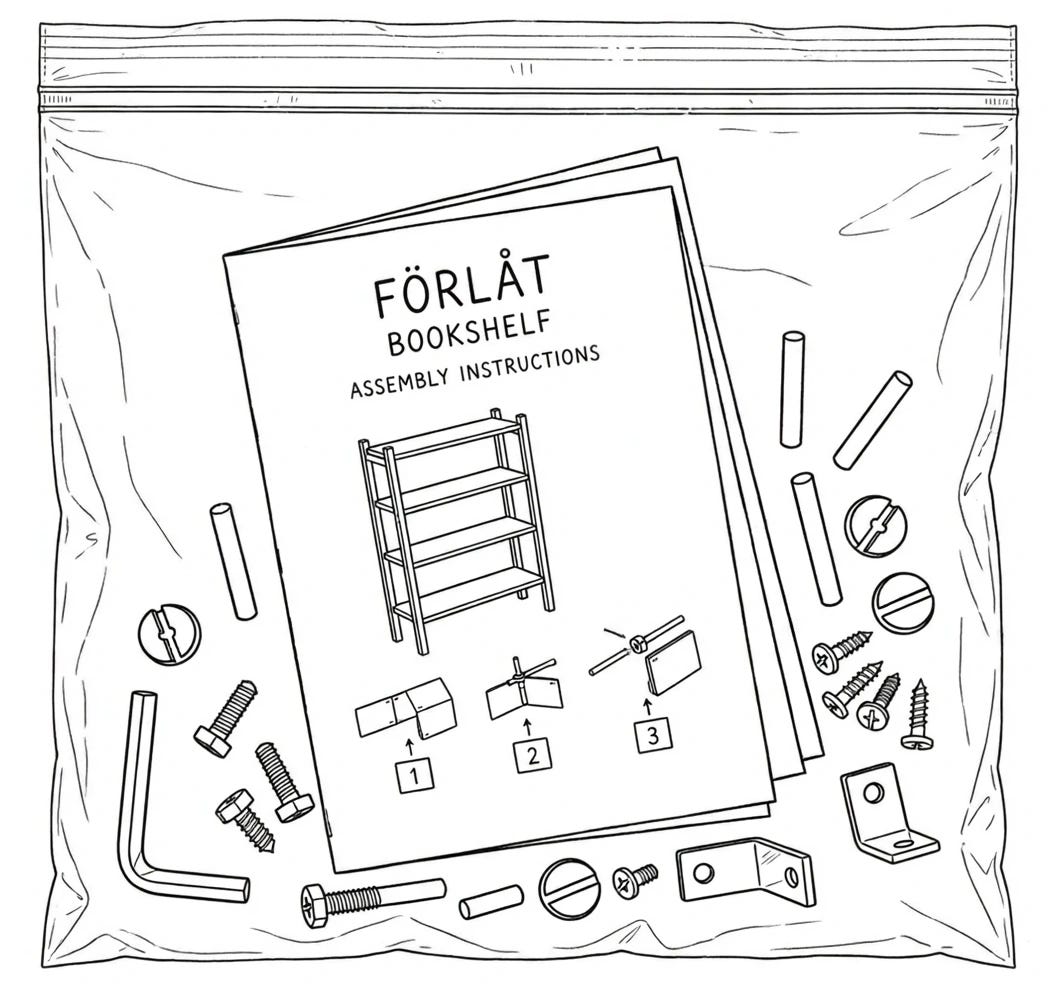
You just got the new FÖRLÅT bookshelf from IKEA…
And you managed to fit it in the car, unload it in the driveway, and haul it up the stairs to your kid’s bedroom. After tearing open the box you find a smattering of little pieces and strange Swedish tools scattered all over the floor.
But after turning the box inside-out, the instruction manual is nowhere to be found.
Now, you saw the thing at the store in its finished state and there’s a picture right there on the box… surely you can figure this thing out, right?
Can you still put it together?
I am serious, and don’t call me Shirley. This thing has dozens of pieces, tools, and tiny little parts that probably connect something to something.
So after a few hours of giving it your best shot, you throw the whole thing in the trash and don’t even bother to go back to the store to buy another one.
This is a shockingly accurate parable for business ownership
Past articles
11/16/26 — Finding your “story” by reviewing trends ($)
11/09/26 — How to create liquidity in your business ($)
11/02/26 — Business lessons from the World Series
10/24/26 — Financial Operating Cycle (flow of money)
10/17/26 — How to conduct a Monthly Financial Review (MFR) ($)
That fully assembled FÖRLÅT bookshelf is your “profitable business” and the instructions are the blueprint to put all of the pieces (your team, your numbers, your products, your processes, etc.) together.
Here’s the problem: there’s no shortage of financial tools, information, or advice. There are thousands of resources explaining how to build budgets, analyze cash flow, measure profitability, etc.
What’s missing for most business owners is a simple, practical system for putting those pieces together.
The good news: This is the central model around our Financial Operating System at Profit Mastery, it’s literally the instructions that don’t come in the box. Check it out here:
Our model is simple:
Tools → Routines → Actions
Pick a few tools
There are tons of financial tools out there, and I’m not talking just software programs. Here’s a list of a few dozen examples just from memory:
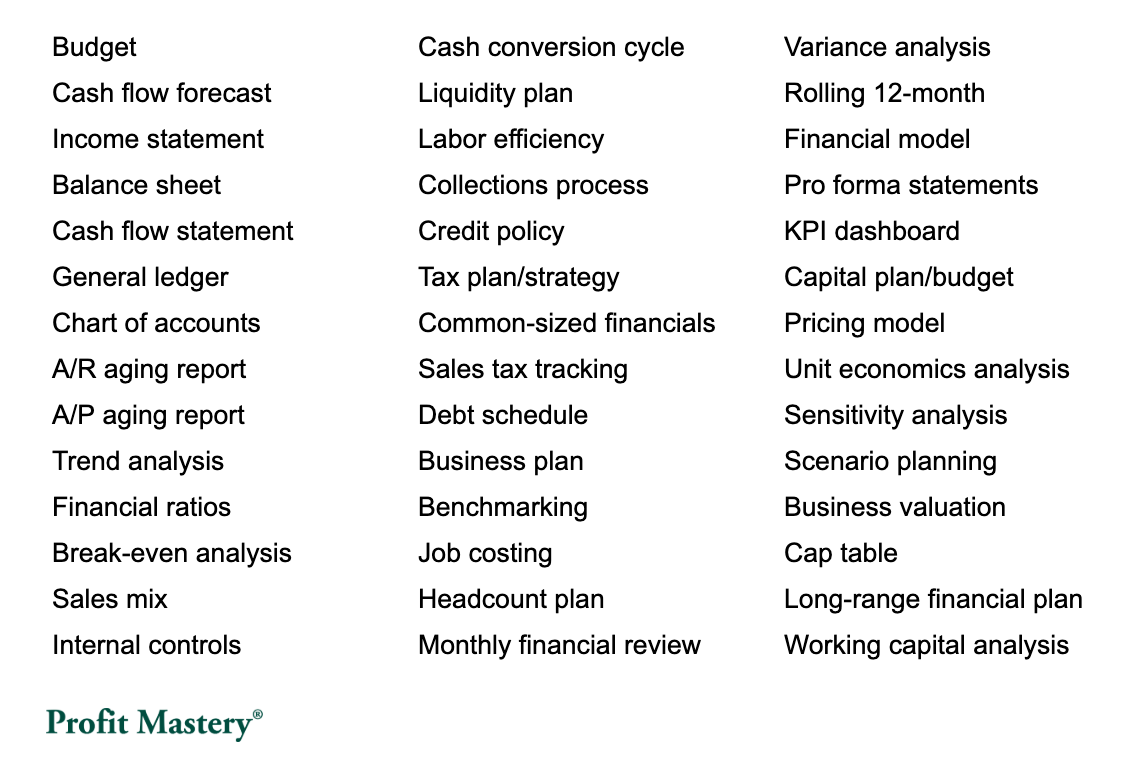
Pick just 3 or 4 things at any given time. Don’t try to solve all of these at once. Your brain cannot hold all of this foreign information while simultaneously managing the other pieces of your business (ops, people, sales, etc.).
My suggested starting point:
Scorecard
Breakeven analysis
Cash flow forecast (13-weeks)
These solve the most problems for the biggest audience.
Once you’ve made these tools a habit (and as your financial sophistication grows), then you start working the next batch of tools into the mix.
As a second layer, I’d add:
Unit economics / sales mix
Monthly financial review (MFR)
3-year forecast and 12-month budget
Rinse and repeat this process every quarter and you’ll build a surprisingly effective financial management system by yearend.
Pick a few routines
What good is a tool without a routine to use it?
Entrepreneurs get stuck in a habit of haphazardly looking at financial information instead of on a consistent, scheduled basis. (Hey, we have a lot of stuff falling on our plate!)
Fortunately, there are really only 4 cadences throughout the year: weekly, monthly, quarterly, or yearly.
For each tool, insert it into one of those review cadences. It’s as simple as that.
Example
Weekly — Spend 30 minutes or so reviewing your weekly cash flow and 13 week cash forecast
Monthly — Spend 30-60 minutes reviewing your scorecard (some months could take less or more time depending on the green/yellow/red status of your numbers)
Quarterly — Check your breakeven and operating leverage to see if you need to adjust costs or pricing
Yearly — Update your 3-year forecast and 12-month budget
Batching tools into a cadence reduces the anxiety around “when should I be looking at what.”
Take a few actions
“There is always something to do. You just need to look harder, be creative and a little flexible.” — Irving Kahn
Financial statements (accounting) are just an output of the actions you’re already taking to run your business. So when you’re reviewing numbers, take notes on what you’re seeing and ask yourself “why?” Why did I get this number (and what was I hoping for)?
The best entrepreneurs already have a bias for action and that same philosophy should apply to your numbers. Sometimes the action is to simply investigate something (understand the root cause) while other times an obvious fix is required.
Let’s take cash flow management as an example:
Tool — A 13-week cash forecast (13WCF) projects takes our historic weekly cash flows and then projects cash coming in and going out over the next 13 weeks.
Routine — Review the 13WCF for at least 30 minutes every Monday morning. During that review you find a $40,000 cash shortfall looming 6 weeks from now.
Action — First, you investigate and find several large customer payments are already late AND a big vendor bill hits the same week as rent and payroll. Next, you double up on collections efforts by personally contacting those customers, and you reach out to the vendor to see if you can get an extra week to make payment. Last, you plan to monitor the cash forecast to see how things change in the weeks leading up to the shortfall.
Takeaway
Back to our botched IKEA project… most of us can’t take our business and just throw it in the trash (even if we wanted to).
Usually the “want” is because it’s not living up to our monetary expectations. And that’s usually because good financial management is complex and unstructured.
Don’t overcomplicate things. You don’t need more stuff, more analysis, more expensive software; what you need is a basic system to run on. So pick a few tools, build a few routines, and take a few actions.
Exercise: systemize your financial management
Tomorrow morning:
Carve out 30 minutes to pick just 3 tools that you want to work on over the next 3 months
Add a review cadence for each one (weekly, monthly, etc.)
Add each one as a recurring appointment to your calendar
During each review, take notes and list the actions coming out of that review (investigate, fix, monitor, etc.)
Become a member
P.S. Profit Mastery Pro members will get early access to a new tool we’ve been working on to simplify this financial operating system concept. If you’re not a already a member, sign up below!