

What’s the typical reaction to the topic of “accounting” among business owners?
Debits and credits (whatever that means)
Something my CPA handles
Accounting = QuickBooks
For those hoping to build financially successful businesses, the late Charlie Munger put it best:
If you don’t understand the accounting, you don’t understand the business. — Charlie Munger
Why is accounting so important?
When looking at your financial statements or tax returns at the end of the year, those numbers represent all the things you did, all the actions you took, throughout the course of the year
Accounting is the literal output of your day-to-day activities running and growing your business
Hired an employee? There’s a financial impact for that.
Bought a piece of equipment? Financial impact.
Opened a new store? Financial impact.
Signed a lease? Financial impact.
And so on…
With a baseline understanding of accounting, you can translate the “actions taken” into the financial outputs which make up your financial statements.
As your ability to read financial statements improves, you can eventually translate the numbers backward to figure out which actions can be taken to drive your desired financial outcomes (goals).
Accounting is both a record-keeping function and a decision-making tool.
Does this mean you need to understand accounting at the same level your CPA does?
Not at all, but you will need a cursory understanding of the core principles, how things work, and what the numbers are telling you.
Let’s start with the basic flow of money in a business…
The Financial Operating Cycle
Balance Sheet
Buy assets to drive sales
Pay for assets with liabilities (other peoples money) or equity (owner money)
Most businesses start life with a balance sheet which is a list of the things you own (assets) and the funding sources which paid for them (liabilities and equity).
There are two sides to every balance sheet and they must equal at all times. It’s a fundamental accounting principle.
Let’s say we want to start a business…
We’re opening an apparel retailer with a physical storefront and a website to sell online.
To start, we’ll need some inventory to sell. Then, we need a store to sell it in and a website to sell on. To take payments, we’ll need a point-of-sale system. If it’s a franchise, then we’ll have to pay a franchise fee too. Last, we can’t forget about leaving some cash in the bank to fund day-to-day operating costs like payroll, rent, etc.
These are assets.
And we need assets in order to make a sale, any sale.
Side note for service businesses: Yes, you’ll need assets too, just fewer of them. Generally, you’ll still need plenty of cash in the bank, receivables for uncollected revenue, perhaps some equipment, or technology hardware.
Sales growth generally requires more assets.
We don’t magically create these things, we have to pay for them somehow. That’s where liabilities and equity (L&E) come into the picture.
Think of L&E as funding sources to pay for those assets.
Liabilities consist of traditional loans like a bank loan or line of credit, amounts owed to suppliers (accounts payable), or credit cards. Think of this as other peoples money.
Equity has two main components to it: (1) what you put in or took out as owner of the company (contributions and distributions); and (2) the cumulative lifetime profitability of the business (known as retained earnings). Think of this as our own money.
Back to our business…
Let’s say all of the assets we need total $250,000, but we only have $150,000 to invest personally (that’s our equity contribution). We go to the bank with our business plan and get a loan for the remaining $100,000.
So we have total assets of $250,000 and total L&E of $250,000 ($150,000 equity and $100,000 liabilities).
Fast forward a few days and we’ve made a few sales (woo!).
Those show up on our income statement (or Profit & Loss, P&L).
Income Statement
Use assets to make sales
Turn sales into net profits
Use net profits to buy more assets, repay liabilities, or take distributions
After turning those sales into profits, we can do one of three things:
Reinvest and buy more assets on the balance sheet. In our example, this would be buying more inventory, improving the store layout, or simply adding to the cash balance. (ASSETS)
Pay off liabilities: repay the bank loan, pay down the line of credit, pay off the credit card, or make those supplier payments as they come due. (LIABILITIES)
Take it home in the form of a distribution (which is one way entrepreneurs are compensated for their efforts). (EQUITY)
You’ll notice the three uses of profits are tied to the three sections of the balance sheet (assets, liabilities, and equity).
This creates a circular flow of money from the balance sheet, to the income statement, and back.
It’s how money flows through your business, my business, any business. And it applies to any size company in any industry. We all abide by this financial operating cycle.
A quick recap of this financial operating cycle:
We buy stuff (assets)
We pay for that stuff with liabilities or equity
We use those assets to generate a sale on the income statement
We turn those sales into profits
We use those profits to either: buy more stuff, pay off liabilities, or take a distribution
Rinse and repeat
This is how a business works.
It’s a beautiful closed loop system of hard working money.
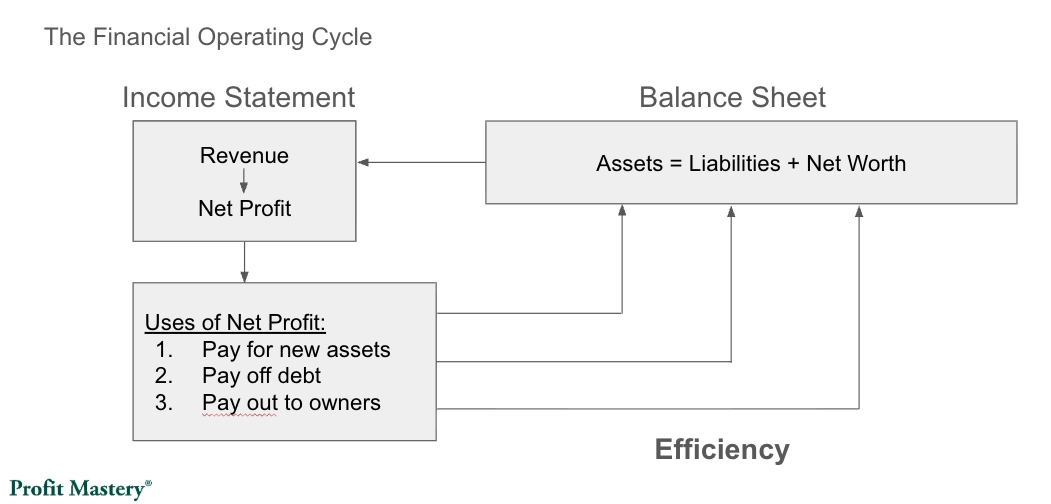
Hopefully this clarifies the interaction between the income statement and balance sheet. No more looking at a single financial statement in a silo… they all work together to tell the complete story of your business.
What to do with this information?
There are three main takeaways here:
Every operating decision eventually shows up in the financials — hiring decisions, inventory stocking, using a credit card, adding equipment, opening a new location, etc. All of these have financial “consequences” and accounting is the language to translate them.
Profit does not automatically mean cash in the bank — Profits can be used to purchase, repay, or distribute across the balance sheet. Building up the cash balance is only one of many outlets for profit.
Growth requires assets, and assets require capital — Businesses generally need more assets to support sales growth, and those assets must be funded with liabilities or equity. Managing these sources and uses of capital is known as “capital allocation,” and it’s both an art and a science. Good capital allocation boils down to deciding where money should go next.
This is, of course, a simplified version of what happens inside a business. But you do not need to be an accountant to benefit from it. Understand this basic cycle, and you will already have a stronger grasp of how your decisions affect profit, cash, debt, and the overall value of your company.
As we continue through the Financial Operating System, we’ll learn how to measure the efficiency of this flow of money (financial operating cycle) using metrics and ratios, so we can eventually refine and improve it.
Try this before you move on…
Pull up your most recent balance sheet and income statement. Print them and lay them out side by side, then spent 15 minutes on this one exercise.
Look up last quarter’s net profit and trace where it went.
Did it turn into more cash in the bank?
More inventory on the shelf or in the warehouse?
Did it pay down your line of credit or credit cards?
Or did it leave the business as a distribution to you?
That profit dollar eventually landed somewhere on the balance sheet (assets, liabilities, or equity).
If you tracked down your net profit, then congratulations, you understand how money moves through your business better than most owners.
Don’t freak out if it doesn’t come to you right away, this concept takes practice. Once you understand this flow of money, financial statement analysis will be a breeze.