

When you meet someone new and they ask what your business does, how do you respond?
We’re in the XXX industry
We make YYY
We sell ZZZ

Now, how does your answer change when talking to the bank? Or employees? Or (most importantly) yourself?
Planning starts with a clear and concise picture of what you do, how you make money, where you’ve been, and where you want to go. As Eisenhower puts it: “Plans are useless, but planning is everything.” These are the basic building blocks necessary before diving deep into the numbers.
There are 3 main components to the planning process:
Business Overview
Financial Situation
Outlook
Let’s start with the Business Overview first…
Business Overview
When I worked as a stockpicker, I noticed public company management teams had an incredible knack for giving crystal clear explanations of how their business works.
You’d be shocked how much storytelling plays a role in good financial management.
After years of listening to investor presentations and reading annual reports, I’ve translated this into a slimmed down version for us ordinary business owners.
The business overview process will emulate the standard public company disclosures shared with their investors (it’s easier than you think); and once completed, you’ll have a document that can be shared with any advisor, banker, investor, or team member to help you accomplish your goals.
Tool: Business Overview Questionnaire
Purpose: Create a plain-English, two-page overview of how the business works.
1) Background
Describe the business in 3–5 concise sentences.
Questions to answer:
What does the business sell (core offerings)?
Who does it serve or what problem does it solve?
Where is the business located or where does it operate?
What is the legal structure and ownership situation?
What are the high level financial metrics (i.e. sales were $2 million last year, headcount was 20, etc.)?
Example:
Let’s say we’re running a single location auto repair shop in the midwest. Our background section may read something like this:
Repair Inc. is a full-service auto repair shop in the Midwest, handling everything from oil changes, brakes, steering, exhaust, to full transmission rebuilds. We serve local car owners and small fleets. We’ve operated out of a single 5-bay location for 12 years and lease our building. The business is a single-member LLC, fully owned by me. Last year we did $1.8 million in sales with a team of 9, including 6 technicians.
2) Products & Services (P&S)
List the major products or services the business sells (these are your “core” offerings).
Not all revenue is created equal. Some P&S are profitable and recurring while others may serve another purpose.
Your “core” offerings should represent 70-80% or more of total sales; so if you have a large catalog (like a distributor with thousands of items or more), then focus on “groups” of core items.
For each core offering, answer:
What is it?
Who buys it?
Is it recurring or one-time?
Is it high margin, low margin, or strategic?
How is it priced (and how does it compare to competitors, if available)?
What makes this core offering unique or different (not every product needs to be truly differentiated)?
Example:
Back to our repair shop…
Let’s say we have 2 core offerings to evaluate:
Oil Change — Range from basic oil change (low cost & low margin) to higher end synthetic oils. Prices vary from $50-200. This service is one-time in nature, but many customers come back a few times each year. We use similar oil products and pricing to competing repair shops.
Fleet Maintenance Plan — Our fleet customers pay quarterly or annually for maintenance plans (recurring revenue). These plans include oil changes and some basic repair services. These plans are offered to our fleet customers with per vehicle pricing. This is where we make good money.
3) Markets
Describe the main customer groups, geographies served, and distribution channels.
Questions to answer:
Who are our best customers?
Who are our worst or least profitable customers?
Are customers concentrated or diversified?
Are we serving consumers (B2C), businesses (B2B), or both?
Are we local, regional, national, or online (i.e. geographic focus)?
What are the primary sales channels (direct, online, distributors, brick-and-mortar, resellers, etc.)?
Example:
We serve 2 primary customer groups — local car owners (B2C) and fleet operators like corporate accounts and rental companies (B2B). A single fleet company is more than 20% of total sales and that account has been with us for more than 10 years. All customers are serviced out of our single Midwest location.
4) Sales & Marketing
Describe how & where the business finds new leads, converts leads into customers, and retains customers as repeat business.
Questions to answer:
How do new customers find us?
What marketing channels generate leads?
Who handles sales?
What is the sales process?
What percentage of revenue comes from repeat customers, referrals, advertising, online search, outbound sales, or partnerships?
Example:
In the early days of the business, we spent money on advertising and mailers. Lately, most of our customers come from referrals or word of mouth. Since a large portion of our business comes from longstanding fleet accounts, we haven’t had to do much marketing to keep sales up.
5) Operations
Describe how the business makes and delivers its product or service.
How does the product or service get to the customer?
What are the key steps from sale to delivery?
What are the key resources in that process (supply chain, facilities, technology, tools, etc.)?
Example:
Most of our services are by appointment. Customers call or email to set a time, we add them to the schedule, and our team of 6 technicians handle the repair work. There are some walk-in customers and we build in capacity to handle those. The basic process includes: technician inspection, quote work, confirm parts and labor availability, invoice at time of completion.
6) Key Roles
List the key roles and people in the business and the top 5 responsibilities for each role (organizational chart).
Total headcount — How many employees (total and direct vs. indirect)?
Team overview — list all roles in the company & the top 5 responsibilities for each role
Example:
Total headcount is 9 employees with 6 direct (technicians) and 3 indirect/overhead employees:
General Manager — Day-to-day management of the business, relationships with fleet accounts, oversees technician team, final review of repair quotes
Office Manager — Billing and invoicing, parts purchasing, customer follow-ups
Admin / Front Desk — Scheduling service appointments, handling walk-in customers, first line for phone and email
Technicians — Timely completion of scheduled service work, perform vehicle inspections, initial repair quoting
A few clarifying notes
This process should take only 45 minutes or so from start to finish and most of these questions can be answered straight from memory. You shouldn’t need to dig deep for answers, and that’s the point.
Your outline should be brief, limit it to two pages max (ideally just one), and very easy-to-read, think a 5th grade reading level.
It should be light on numbers. Yes, there will be some financial figures you want to include: total sales, percentage mix, margins, etc. Just keep them high-level ($2.1 million instead of $2,147,092.67).
What’s the point of all this?
As business owners and entrepreneurs, we have a tendency to get deep into the weeds and focus on the details which can be great for execution; but when it comes to the finances, we need to occasionally step back and look at the big picture (we’ll frequently refer to this as “zooming out”).
Think of this business overview as a mini questionnaire leading to a super concise descriptor of your company — what you do, what you sell, how things work.
So what do we do with this information once we have it?
Step back and think about what you’ve just created — this is the story or narrative behind your business.
You’ve just given me a qualitative description of how things work.
As we review the numbers and build tools throughout the rest of the system, it should connect dots to this business overview. If it doesn’t, then something is either missing in the numbers or missing in the story.
A few other situations make this a valuable tool:
Identify gaps in the business — distribution channels missing, sales & marketing tactics that are lacking, gaps in the organizational chart, etc.
Capital raising — When you’re going to raise money, whether it’s a bank loan or investor money, this will help concisely explain your company and make you look like a professional.
Managing the team — When you’re working with your team to help them understand how the business currently operates vs. how it should operate (plus where they fit (role) in the context of the business)
TL;DR
Create a written outline of your business across 6 areas — background, products & services, markets, sales & marketing, operations, and key roles — using the Business Overview template.
Before you can plan for the future or optimize your financial situation, you need to clearly understand what you already own.
Bonus: Real World Example
To show you just how simple this process really is, I’ve included excerpts from BrightView Holdings Inc. 2025 annual report.
See if you can quickly and easily imagine what this company does and how it operates:
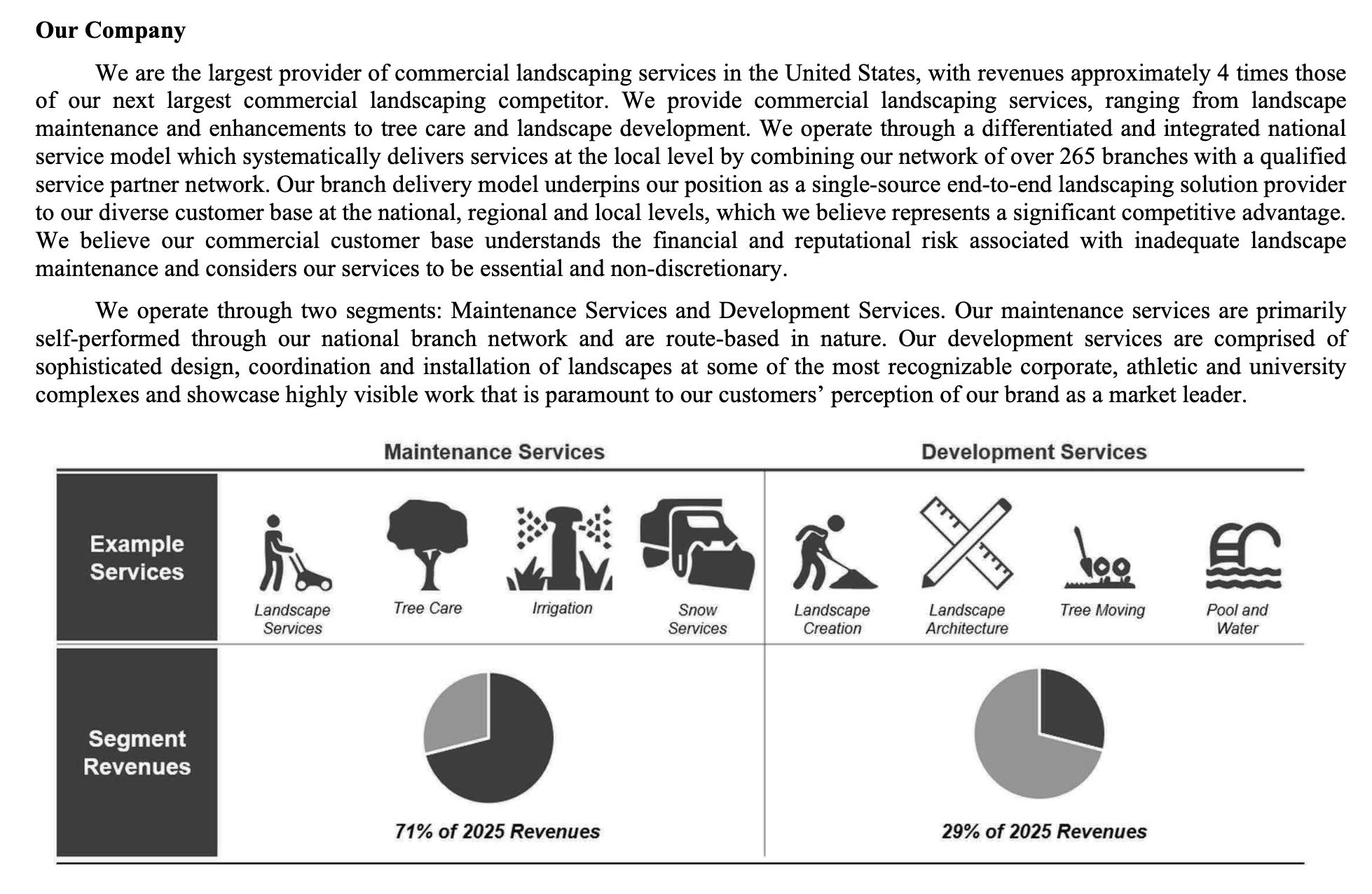
Here’s a real-life excerpt describing BrightView’s branch network organizational chart:
Our maintenance services model is grounded in our branch network.
For example, a representative maintenance services branch typically serves 25-150 customers across 50-250 sites, generating between $5 million and $20 million in annual revenues. Each branch is led by a branch manager, who focuses on performance drivers, such as customer satisfaction, crew retention, safety and tactical procurement. Branch managers are supported by operations managers, who focus on managing crew leaders, and account managers, who focus on customer retention and sales of landscape enhancement services. Each branch is also supported by 1-2 dedicated business developers, who are focused on winning new customers at a local level.
Adding to this description is a structured diagram outlining how each branch works:
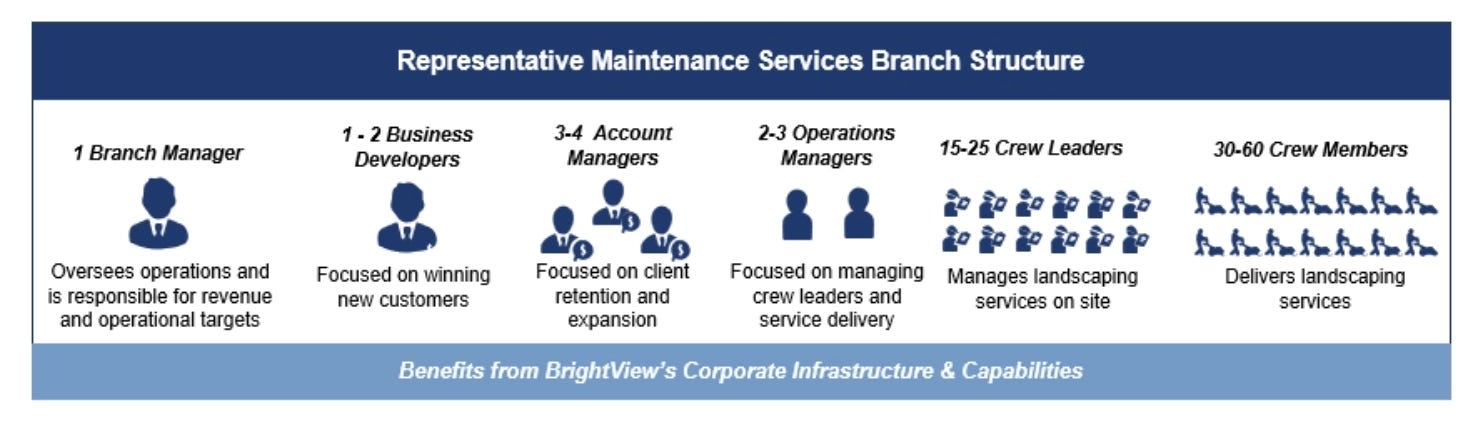
Imagine you’re an employee (or the owner!) at a single branch location and you’re handed this description and visual… this level of clarity around “where you fit in” from a hierarchy standpoint is truly empowering.