

You spent 30 minutes reviewing your numbers, now what?
Last time, we looked at a simple framework to read a set of financials in 30 minutes:
Pull the right reports
Simplify the information
Get a quick read on each of the 3 statements
Now what?
Think of this as Part 2. You’ve got your statements in front of you, scanned them using the 30 minute framework, now you’re asking what’s next.
Below are 4 questions I ask clients to help them identify the actions needed to improve their finances.
I was recently talking with one of our Pro members, and literally worked through these 4 questions to pinpoint “the most important thing” for their business.
(Quick reminder: at minimum, you want your monthly P&L and a rolling 12-month income statement. That’s all we’re using here.)
Question #1: Is revenue growing?
This question always comes first.
Everything else in our analysis depends on the answer here.
It’s not impossible, but it’s certainly more challenging, to optimize for profitability without knowing whether you’re dealing with a growing business or declining business.
We define “growth” as sales increasing from the same period last year (year-over-year growth).
Is revenue growing?
If the answer is yes — You have more revenue dollars to work with. Every company needs a certain amount of revenue to achieve breakeven, and a certain amount of revenue to achieve a profit target. Your assignment is to make sure sales & marketing programs are producing for you (call this “monitor & maintain”).
If the answer is no — No amount of cost-cutting will fully compensate for a shrinking revenue base. You will have to solve both simultaneously. Your action is to look at your sales & marketing tactics to understand: (1) how to find new customers; and (2) how to retain the ones you have.
If you’re #2 above, then revenue growth is your “most important thing,” full stop.
Here are the revenue trends from our sample company:
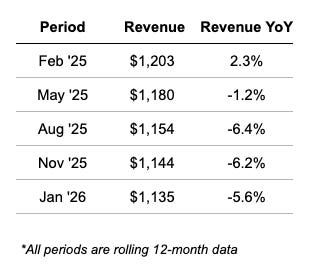
Action Plan — This business is showing persistent revenue declines, we need to understand why, and then how we plan to reverse this trend. Growth is hands down priority #1 here.
Question #2: Are gross profit dollars and gross margin increasing?
Every dollar of revenue has costs attached to it.
Simple example: I can’t sell you a $15 t-shirt without first buying or making that t-shirt. That’s my cost of goods sold (COGS). Whatever’s leftover after making the sale is my gross profit. Multiply by however-many sales transactions you have, and that’s your business’ gross profit.
Two things to check here:
Gross profit dollars — Are they going up in dollar terms? More gross profit dollars means more money to cover overhead and create profit (good).
Gross margin — Larger gross margins mean more profit per sale (good). If gross margins are shrinking, then prices might be too low or costs to make/deliver/service might be creeping up.
Here are gross profit/margin trends for our case study:
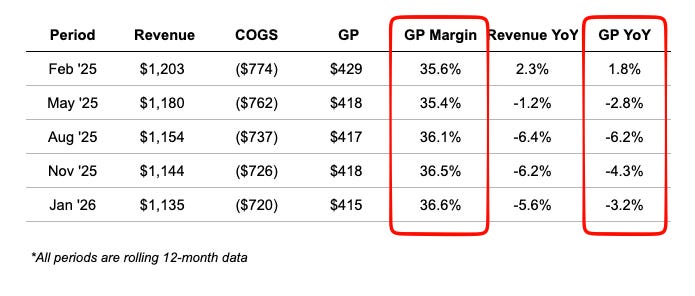
The sample company has steadily climbing gross margins while gross profit dollars are falling…
This is because revenue is declining. So we have healthy profit-per-sale which reinforces our need to turn around the sales slump here.
Action Plan — Monitor gross margins to maintain current levels. Fix revenue growth to improve gross profit dollars.
Question #3: Is net profit growing?
Net profit is the business equivalent of take-home pay.
If you want to get wealthy, then you need more of it.
A few things to check beyond the obvious “is it growing”:
Is net profit growing faster than revenue? If yes, that’s leverage (spreading sales dollars over fewer overhead dollars). The business is becoming more efficient (good).
Is net profit growing slower than revenue? That means costs are growing as fast or slightly faster than sales. The business is working harder but not necessarily getting richer.
Is net profit shrinking while revenue grows? This is a huge red flag. It’s possible fixed costs were added to fuel growth and sales haven’t “caught up” yet. But usually, it’s the result of too much additional overhead.
Here are the net profit trends from our case study:
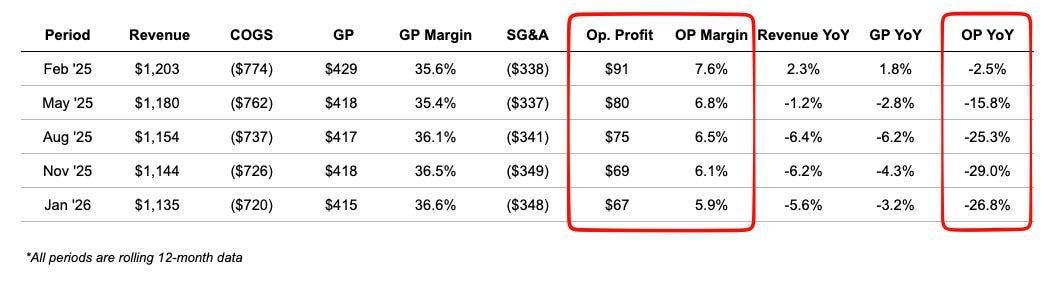
Our sample company shows rapidly shrinking operating profit and margins. It’s falling off a cliff so to speak.
This is a result of higher overhead expenses (SG&A) despite lower revenue (category #3 from earlier).
Action Plan — We need to investigate the overhead expenses to see where we’ve added costs… Is it higher rent expense? Or maybe more overhead labor? Or something else entirely?
Question #4: Are fixed costs flat (or growing slower than revenue)?
Fixed costs (overhead) are expenses you pay every month whether you sell anything or not: rent, salaries, software, insurance, loan payment, etc.
Maintaining fixed costs while growing sales is the “holy grail” of profitability.
The benchmark here is simple: revenue up $1, overhead up less than $1. If we’re meeting that criteria, then we’re getting leverage in the business.
In our sample company, we saw overhead expenses increase from $338 as of Feb 2025 to $348 as of Jan 2026.
This is pretty common since most expenses go up each year (just look at your latest insurance bill).
Action Plan — This is where I’m trying to identify cost-cutting opportunities, what can be reduced or eliminated based on the size of the business. If there aren’t any costs to eliminate, then it further reinforces our need for sales growth.
The Case Study
Back to our sample company:
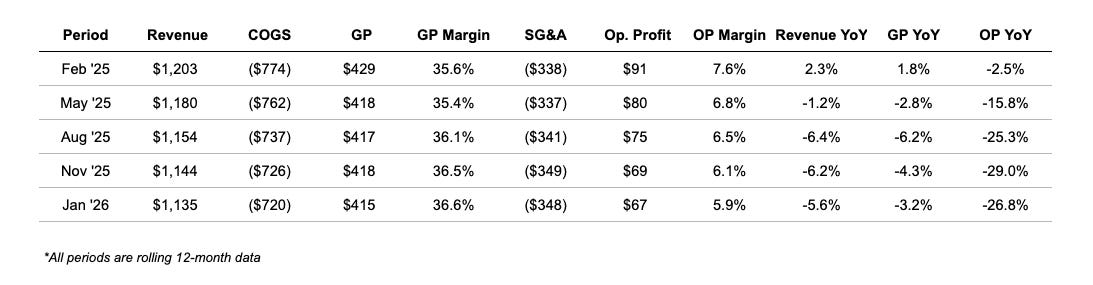
Summarizing the 4 questions and what this company should be doing next:
Q1 — Is revenue growing? No. Revenue declined from $1,203 to $1,135 over the past ~year, we’ll call that a 5–6% year-over-year decline rate. After this analysis, the very first thing I’m doing is investigating our sales and marketing campaigns (current and potential), customer retention, and sales mix.
Q2 — Are gross profit dollars and gross margin increasing? Mixed. Gross margin? Yes (from 35.6% to 36.6%). Gross profit dollars? No, these are declining because revenue is shrinking. Profit-per-sale (margins) look healthy, but the dollars reinforce the need for revenue growth.
Q3 — Is net profit growing? No. Operating profit dropped from $91 to $67 (26% decline) and margins compressed from 7.6% to 5.9%. If we don’t think revenue growth is going to return, then we need to start looking at cutting some overhead here.
Q4 — Are fixed costs flat? Yes, with caveats. SG&A is basically flat (from $338 to $348). But that’s during a period where revenue fell by ~$68… so costs are up $10, but sales are down $68. Again, we need to start looking at cutting some overhead.
Diagnosis
Four questions and we know the story here:
This is a business with a revenue / growth problem (bad). The cost structure is reasonably controlled (good). Margins at the unit level are actually improving (good). But the top-line decline is flowing through to profit faster than management can respond (bad).
Maybe there are some overhead costs to cut here, but this business has a revenue problem and should be plowing their energy into fixing growth.