
“The main thing is to keep the main thing the main thing.” — Stephen Covey
In the words of my business partner, 2026 is the year of simplicity and profitability (feel free to borrow that motto).
I’ll set aside the “simple” part of that equation for now; as I reflect on how we’ve achieved profitability in past years and how we’ll add more of it in 2026, I’m boiling it down to three simple ingredients:
Grow revenue
Dial in our unit economics
Control our fixed expenses
1) Revenue growth
You’ve probably heard the adage: “if you’re not growing, you’re dying.” But have you ever asked why that’s the case?
Check out this not-so-long-term chart on the purchasing power of the US Dollar.
If you were making a $100,000 profit ten years ago, it’s now worth just $73,000 because of inflation.
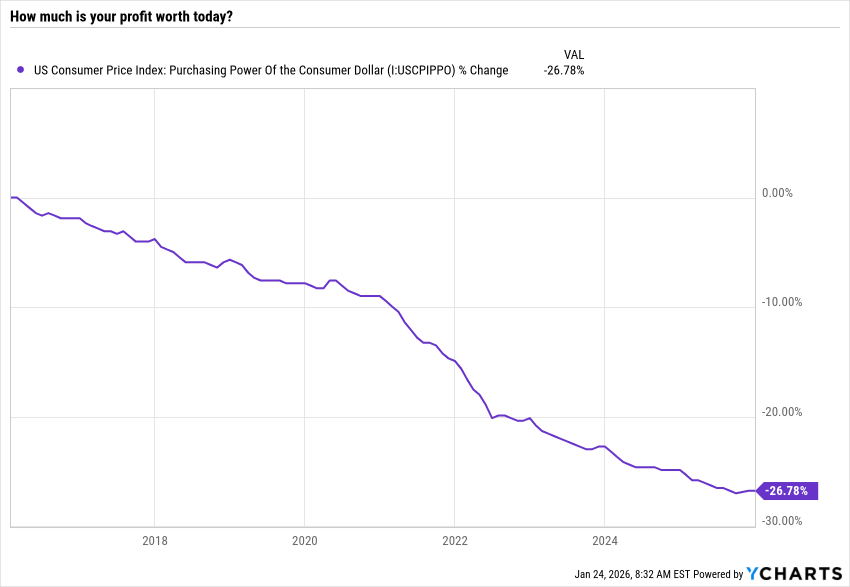
Let that sink in. This means ten years from today, you’ll need to be making $136,000 just to maintain the same buying power of today’s $100,000. This is why we must grow.
And unfortunately for business owners, this is happening on two levels: first, with the costs to run your business (labor, materials, services, etc.); and then when you use your profit as a consumer to buy goods and services.
We’re fighting a war on multiple fronts here.
It’s possible for a company to maintain or improve profitability without growth for brief periods of time, but it’s not sustainable over the long run.
Without getting into the meat of “how to grow revenue,” let’s start with some basics:
Defining revenue growth — I think of revenue growth as “this period vs. the same period last year” (known as year-over-year, or YoY, growth rate). It can be measured on a daily, weekly, monthly, yearly basis. Example: last month sales were $1,000 and the same month last year was $990 = 1% YoY growth.
Knowing your growth rate — Growth rates ebb and flow throughout the year and they’ll vary from a weekly-to-monthly-to-yearly view. Think of it as a range, not a single number. Your weekly and monthly growth rates give you a view into short-term trends (i.e. what’s happening right now) while quarterly/yearly growth rates are your long-term trends. Pay attention when the short-term view starts to diverge from the long-term view.
2) Unit economics
This is one of my favorite concept since it rolls 3-4 pieces of profit measurement together — pricing, unit costs, delivery costs, etc.
What are unit economics?
It’s your unit-level profitability. It measures the profitability of a specific business model by looking at one single unit of what you sell. It can be measured by product line (product, service, customer, etc.) or by sales channel (store, website, wholesale, Amazon, etc.).
Sketching out the unit economics for your business is incredibly valuable to understand where you’re making money and where you aren’t. There’s an added benefit to doing this annually in that you’ll see how profitability is changing over time.
Here’s a super simple example of unit economics for different product lines in a business. This could be a view of a standard product (A), a higher price point item (B), and a wholesale/bulk offering (C).
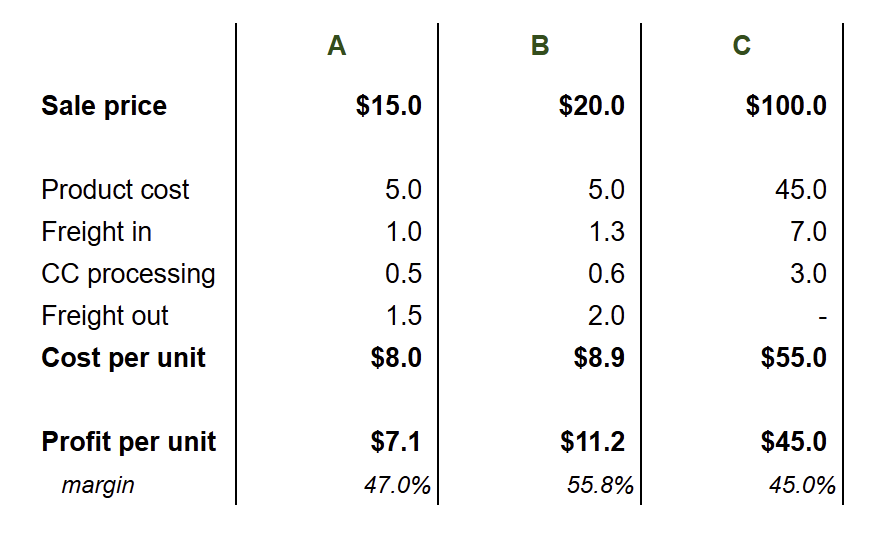
Which of these would do you want to focus your efforts on?
It sure helps to know these economics when answering that question!
Write down your top 3-4 product lines or sales channels
Think about all the costs that go into a single sale
Sketch out these calculations for each product/channel
Keep it simple and don’t get hung up on complete accuracy
Tracking unit-level profitability reminds me of Buffett’s view on pricing power in a business (a key input):
“The single most important decision in evaluating a business is pricing power. If you've got the power to raise prices without losing business to a competitor, you've got a very good business.” — Warren Buffett
Where do you have pricing power in your business?
It may not be everywhere, but surely you have at least one product, channel, or customer group which has pricing power over time.
3) Fixed expenses
Fixed costs do not change regardless of sales.
You pay for these whether sales are $1.00 or $1 million, which makes these expenses very important, if not critical, to business success. It almost feels criminal not to track them!
And it baffles me why this concept isn’t baked into more P&Ls.
As a small business owner, you have flexibility in crafting your chart of accounts (i.e. how your financials are displayed). Design your financial statements to closer align with this fixed vs. variable concept.
Example: track salaried vs. hourly wages as two separate expense lines, don’t commingle credit card processing charges with bank fees, split out paid advertising from marketing agency costs.
Once you start paying close attention to them, it becomes much easier to keep them fixed and only grow them when needed. After a while, it will pain you to add to your fixed cost base!
Here’s what overall profits look like with revenue growth + flat fixed expenses:
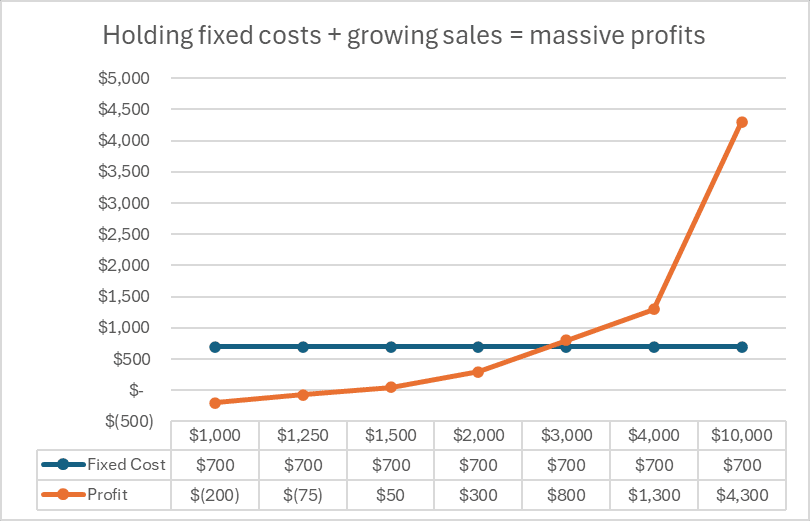
In this example, sales grew from $2,000 to $10,000 (a 5x increase), but profit grew from $300 to $4,300 (a 14x increase). That's called leveraging your fixed costs, and it's powerful stuff!
For now, this starts with: (1) understanding which costs are fixed and which are variable; and (2) designing the income statement to (very) clearly show these fixed vs. variable costs.
Good management starts with good measurement.
Homework — Grab a sheet of paper to find your growth rate + unit economics + fixed costs. Check your YoY sales for the past 3 months, then look at the last 3 years; what’s your growth rate? Then, calculate your margin for your top 3 products/services; which is the golden goose? Last, separate your fixed/variable costs on your P&L; how did they change over the last few years?
P.S. hit reply if you’re completely stuck on where to start with this!