

How do you achieve your financial goals?
Work hard for decades and slowly accumulate desired profitability
Work hard for decades and sell the business to fund retirement
Buy a company worth 5-6x more than yours
While #1-2 are probably the conventional paths, #3 sure would be faster.
GameStop (GME) recently announced an offer to “buy” eBay for $125 per share despite being worth roughly $10bn while eBay is worth 5x that. (P.S. for a good chuckle, watch the incredibly awkward CNBC interview with GameStop CEO Ryan Cohen.)
At first glance, this sounds crazy.
But it could be genius; and there are lessons here for every business owner.
First, let’s explain the mechanics of how a $10bn company could purchase a $56bn company (it’s one of the more interesting financing stories I’ve seen in a while); and second, I’ll highlight how all entrepreneurs need a little bit of “crazy + dreamer” to play this game we call running a business.
Minnow swallows whale financing
How is it possible GameStop could acquire eBay for $56bn?
Let’s look under the hood of this offer…
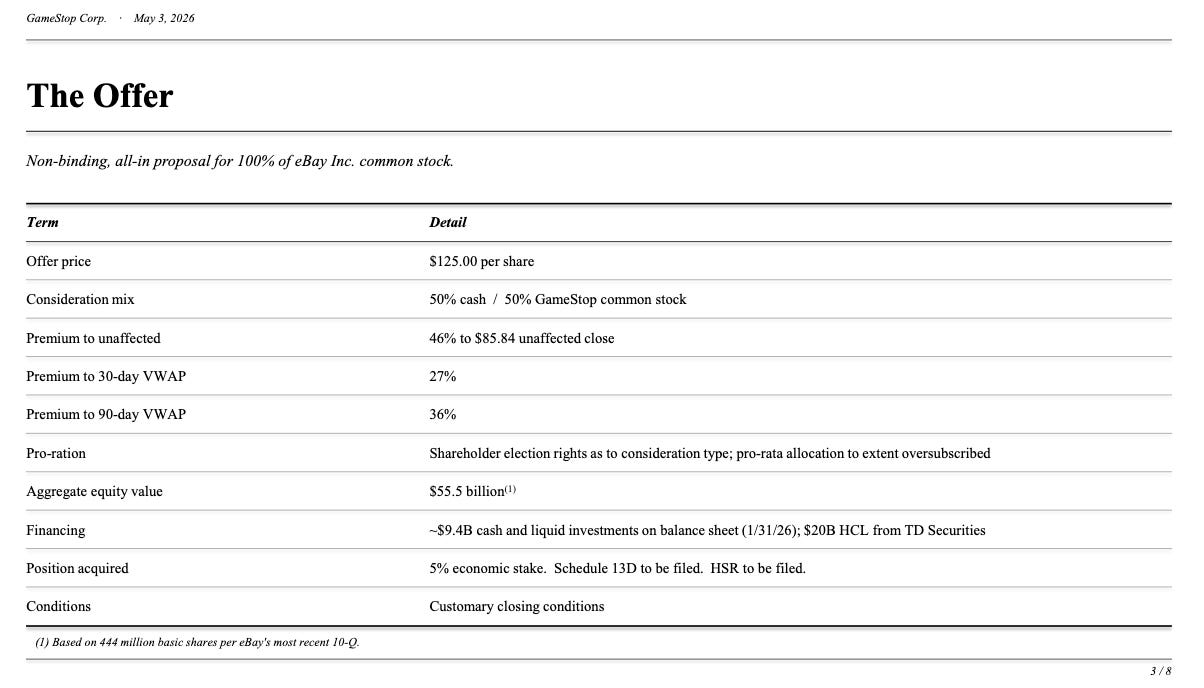
There are 2 components to this deal:
Cash — The deal terms call for 50% of the $56bn offer price to be paid in cash at closing which is $28bn. GameStop has $9bn cash on hand so they’ll need to borrow a lot of money; fortunately, they have a letter from a bank stating they are “highly confident” they can arrange $20bn of financing. Great.
Stock — The remaining 50% of the offer price (again, $28bn) will come from GameStop issuing equity to eBay’s owners. As of today, GameStop trades at a ~$10bn market cap (roughly $22 per share) which means they would give eBay owners about 74% of the combined company.
To recap: they will need to borrow a huge sum of money (assuming lenders will give it to them) and then give away most of the ownership to get this deal done.
Technically, eBay is buying GameStop under these terms.
Quick example — Let’s say you own 100% of a business worth $1m and decide you want to “buy” your neighbor’s competing business for $6m. You borrow from the bank to pay him $3m, then you give him 74% ownership in the combined company
Your ownership stake drops from 100% to 26%, when would this ever make sense?
Well, presumably your neighbor’s business is quite a bit larger (and perhaps more profitable too). Then, there are likely redundant costs (do we really need 2 warehouses when 1 will do?). And then there’s the larger staff which could reduce all the balls you’ve been juggling the past few years.
Let’s make even more sense of this situation…
Your business (worth $1m) had $250k net profit last year (an achievement you’re quite proud of). Your neighbor? His business did $2m in net profit, a full 8x more than you.
So you go from owning 100% of a business with $250k profit, to owning 26% of $2.25m (before interest expenses). Your share of profit works out to $585k with some intangible benefits like a bigger team and the potential to wear fewer hats. Not bad.
This is why M&A can be so lucrative when done right.
How about the neighbor, why should he take this deal?
Well: (1) he gets a big chunk of cash upfront (the $3m); (2) he gets to keep majority ownership (74%) of the combined company; and (3) he now has a business partner with ownership experience to help build & grow (that’s you).
Remember the saying: “If you want to go fast, go alone. If you want to go far, go together.”
We’re in the arena trying stuff
A few things I’m taking away from this deal announcement…
Entrepreneurship consists of lots of little experiments to find what works
The opposite of a good idea can be a good idea
Bet big when it makes sense to do so
You need irrational optimism
1) Entrepreneurship consists of lots of little experiments to find what works
I really like this tweet from Chamath Palihapitiya:

It’s a solid description of the business owner daily routine... each day, we’re trying “stuff” in the hopes we’ll find something that works. The “stuff” are lots of tiny experiments and actions which compound over time. Could be a marketing campaign like a first ever postcard mailer or TV commercial, or maybe it’s automating a routine task with AI.
Low-risk experiments create upside optionality.
2) The opposite of a good idea can be a good idea
One of my favorite quotes comes from the book Alchemy by Rory Sutherland. In it, he says: “sometimes the opposite of a good idea, is a good idea.”
This principle can work all over your business…
If your business is facing sustained losses because you haven’t reached the breakeven sales point, then maybe you need to add to your marketing expenses instead of pulling back on them.
Or perhaps the next “level” of earnings requires a leap of faith, like opening another location, making a critical hire, or a “scary big” investment.
As you brainstorm tactics for growing & managing your business, consider the opposite side of each tactic too.
3) Bet big when it makes sense to do so
You need to consistently think big. Sometimes that big thinking translates into acting “small” (like the tiny experiments examples above), but occasionally this big thinking can translate into big bets.
When it comes to thinking big:
Choosing goals that genuinely stretch you
Working on problems that matter beyond the next paycheck
Making decisions based on where you want to be in 3-10 years
Check out the full article on thinking big here:
Placing big bets is a different animal.
This GameStop / eBay deal is a big bet.
When it comes to big bets, do your homework, know your numbers, and go for it with confidence. As Charlie put it:
“The wise ones bet heavily when the world offers them that opportunity. They bet big when they have the odds. And the rest of the time, they don’t. It’s just that simple.” — Charlie Munger
4) You need irrational optimism
For 10+ years, I’ve dreamt of building my own Berkshire Hathaway in the footsteps of the world’s greatest investor, Warren Buffett.
That’s a crazy dream which most listeners will (and do) tell me is futile. Now, I’m 8+ years and 17 business purchases into this journey and still building.
Fortunately, I have an awesome business partner with complementary skills and an equally ambitious mindset. This makes it easier to explore and test big ideas.
As impractical as it sounds, you need to eliminate any limiting beliefs when it comes to running your business and making money. Yes, you can do this.

Have a crazy dream and pursue it seriously.
TL;DR
The GameStop/eBay deal is a useful case study in “big bet” financing structures.
Entrepreneurship is a series of small experiments which compound over time
Good ideas can come from anywhere (even from bad ideas)
When the odds are in your favor: do your homework and bet big
Run your business with “irrational optimism”
P.S. if you find this content valuable, give this article a “like” and share it with someone! help us spread the word!
Upcoming webinar
Profit Mastery teaches business owners how to read & use their financial statements to make more money (profit).
We’ve developed what we call a “Financial Operating System” — a set of tools, a cadence to review them, and the actions coming out of that review.
We’re hosting a webinar on the first section of this Financial Operating System this Friday (May 22nd). It’s free for PM Pro members and $39 for non-members.
Grab your spot using this link: