

What a $1.50 Sandwich Can Teach You About Business
Ever wonder why a business would purposefully charge less than it could for a product?
Some of you may have caught the Masters Tournament at Augusta National last weekend and noticed the absurdly cheap menu items available: $1.50-3.00 for sandwiches, snacks at $1-2, drinks for $2-5.
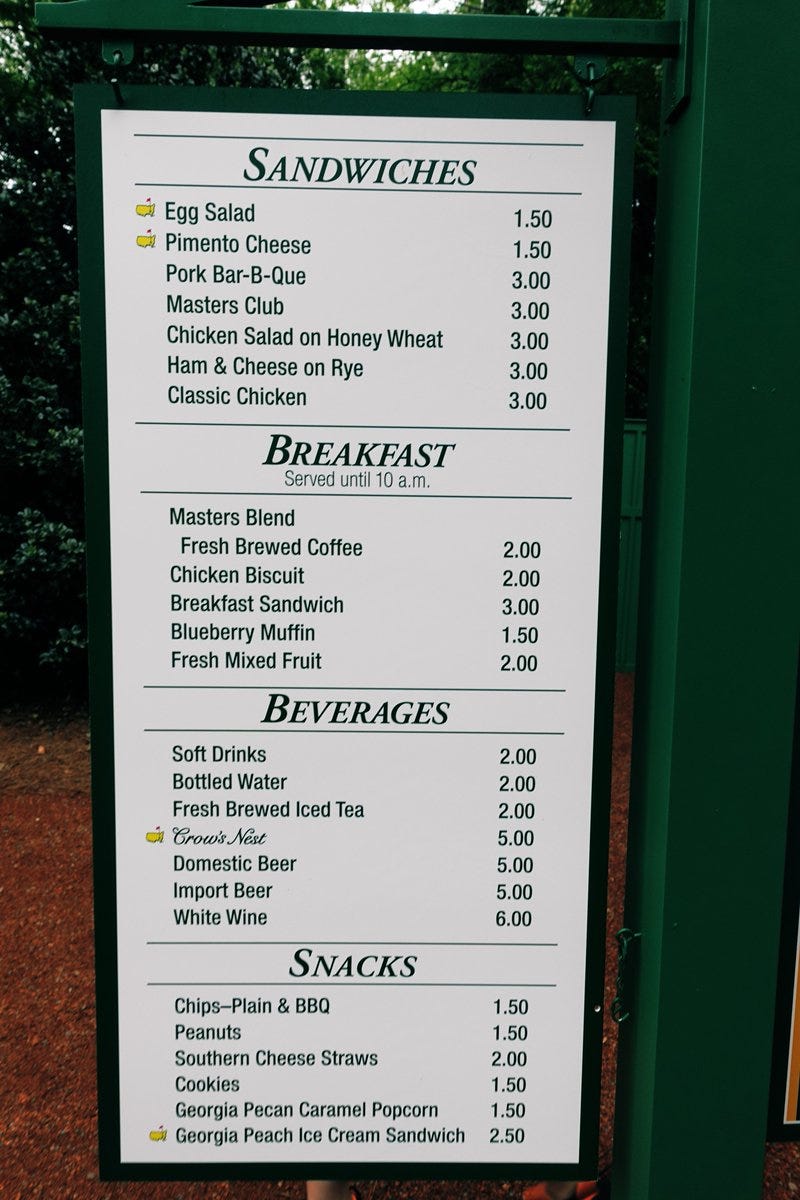
You could build an entire meal plus a beer to wash it down for just $10-12 all-in. The same setup at a football game might run $30 or more.
What does this have to do with your business?
There’s actually a lot of interesting strategy behind this pricing decision and maybe some parallels we can draw to running your own company…
For starters, the Masters generated ~$153 million in revenue in 2022 (according to Forbes). What were the sources of that revenue?
Merchandise was ~$70 million (46%)
Ticket sales ~$40 million (26%)
TV rights & sponsorships $35m (23%)
Concessions of just $8 million (5%)
Compared to other event venues, they’re leaving a ton of money on the table when it comes to food & beverage. No one would bat an eye at prices 4-5x higher.
Why do it?
Because the $1.50 sandwich isn’t just a “concession,” it’s marketing.
Every year, without fail, this story goes viral. Journalists write about it, fans post about it on social media, regular people who have never watched a golf tournament in their life share the story; because it feels genuinely incredible in a world of $15+ stadium beers.
Augusta National Chairman Billy Payne said back in 2007:
“We take certain things very, very seriously. Like the cost of a pimento cheese sandwich is just as important as how high the second cut of grass is going to be.”1
The sandwich is a legitimate part of the brand here.
So how can they “afford” to do this?
Let’s think back to that revenue mix and the product margins behind each of those streams…
Merchandise is likely a 40-60%+ category (apparel, gifts, etc.)
Ticket sales are probably the lowest margin (think of all the production costs to operate the event) at 0-20%?
Broadcast rights and sponsorship dollars are very high margin at maybe 70-80%
Blended, those 3 income streams work out to $50-60m before overhead. Under normal prices and margins, concessions could add another $15-20m, but instead they’re probably breakeven at best.
It’s a testament to the power behind these other high margin revenue streams.
There’s a similar playbook over at Costco (as I’m sure many of you are familiar with $1.50 hot dog).
Founder Jim Senegal said to then CEO Craig Jelinek: “If you raise the effing hot dog, I will kill you. Figure it out.”2
Costco’s reasons are slightly different (it’s “on brand” for them as a low-cost leader to maintain such a ridiculously low price and therefore somewhat symbolic), but the outcome is the same = viral marketing.
How to apply this to your business
The Masters can afford to aggressively price (market) their food & beverage at such low prices because the engine of the business runs elsewhere (merch, broadcasting, sponsorships, tickets).
And adding fuel to that engine is the mystique/prestige/scarcity behind the whole thing (I saw an ad for a $200,000+ car at one point).
The food is a loss leader that pays dividends in brand equity you couldn’t quantify on a spreadsheet.
The main takeaway is the power of having multiple revenue streams with different economics (especially when one part of the business is highly profitable). This gives you the freedom to be strategic somewhere else in the company. You can afford to make decisions that don’t make sense on a spreadsheet.
Most small business owners don’t think this way (myself included, I’m a card-carrying spreadsheet jockey) and that’s exactly the opportunity here.
Let’s try to apply this now…
Ask yourself 3 questions:
First, where are your real profit centers? Every company has some product or service which carries better margins. Do the unit economics work and see which parts of your business are carrying the most weight.
Second, if that “super high margin” product or service doesn’t yet exist, where could it be? Is there something you currently do which has the potential to be that mega-margin segment?
Third, where is there potential to price aggressively as a marketing investment rather than a profit center? Maybe it’s a front-end service that ultimately leads to higher margin work? Maybe it’s something you can provide at a substantially lower cost than competitors?
This doesn’t have to be complicated.
I’m just trying to get the wheels turning for you
Frankly, this setup may not exist in every business, I just want more businesses getting off the hive-mind virus that is digital paid advertising (most owners treat Google/Facebook ads as the only means to marketing).
Homework
Grab a piece of paper.
Look at your product or service catalog and write down all the different streams coming in today.
What’s your “pimento cheese sandwich” (the thing you could price aggressively)
Then ask: do you have the revenue base to support it? If product A has a 60% margin, can it subsidize an intentionally low-margin product B that acts as marketing for you?
TL;DR — A cheap price on the right product or service isn’t always just a discount, sometimes it’s a massively differentiating factor for your business.
https://www.npr.org/2026/04/09/nx-s1-5779202/masters-concessions-prices-augusta-national
https://www.foodandwine.com/news/why-costco-hot-dog-still-dollar-fifty